Custom vs Ready-Made Pharmacy Software: Cost Comparison
Compare custom and ready-made pharmacy management software costs. Discover what fits your budget, growth goals, and long-term strategy. Read now.
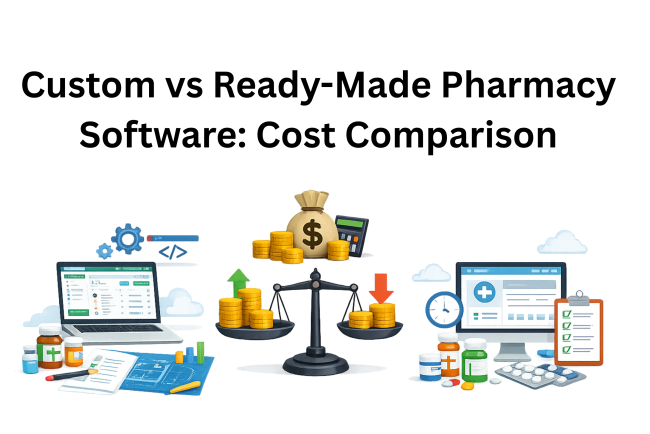
Choosing between custom and ready-made pharmacy software is rarely just a technical decision. For enterprises and growing pharmacy chains, it’s a financial and strategic call. The wrong choice can quietly increase operational costs year after year. The right one becomes a long-term asset.


If you're evaluating pharmacy management software, this guide breaks down the real cost differences in practical business terms.
Ready-Made Pharmacy Software: Lower Entry, Ongoing Costs
Ready-made solutions are pre-built systems designed for mass usage. They typically include billing, inventory tracking, GST management, prescription handling, and basic reports.
The main appeal is the lower upfront investment.
You usually pay:
-
Monthly or annual subscription fees
-
Per-user charges
-
Set-up or onboarding costs
-
Additional fees for premium modules
For single-location pharmacies or small businesses, this model can work well. You get quick deployment and predictable short-term expenses.
However, as your operations grow, subscription costs scale with you. Adding new branches, users, or advanced features often increases recurring payments. Over time, these add up.
Custom Pharmacy Software: Higher Initial Investment, Long-Term Control
Custom systems are built specifically for your workflows and expansion plans. Through a structured pharmacy software development process, the solution is tailored to your operations, compliance requirements, and integration needs.
The upfront investment includes:
-
Requirement analysis and planning
-
System architecture design
-
UI/UX development
-
Backend and frontend engineering
-
Testing, deployment, and integrations
The initial cost is higher. But unlike subscription software, you own the system. That ownership changes the long-term financial picture.
Where the Real Cost Difference Shows Up
The difference is not just what you pay today. It’s what you pay—or save—over five years.
1. Scalability Costs
With ready-made software, scaling usually means upgrading plans. More users. More licenses. More fees.
With custom-built pharmacy management software, scalability is built into the architecture. Expansion does not automatically increase per-branch subscription charges. You scale on your terms.
For enterprises planning growth, this matters.
2. Integration and Workflow Efficiency
Modern pharmacies rarely operate in isolation. They need integration with ERP systems, CRMs, hospital systems, payment gateways, and supply chain platforms.
Ready-made tools may offer limited integrations or charge extra for them. Sometimes, workarounds are required.
Custom pharmacy software development allows direct API integrations from the beginning. That reduces manual work, data duplication, and operational friction. Over time, improved efficiency translates into measurable cost savings.
3. Automation and Error Reduction
Manual billing errors. Missed expiry dates. Inventory mismatches. Compliance gaps.
These small inefficiencies quietly cost money.
Custom systems can automate:
-
Batch and expiry tracking
-
Auto reorder alerts
-
Multi-location inventory sync
-
Compliance reporting
-
Advanced analytics
Ready-made systems often provide basic automation. But deep operational alignment is rarely possible without customization.
Efficiency is not just about convenience. It directly impacts margins.
Maintenance and Vendor Dependency
With ready-made software, updates and feature improvements depend entirely on the vendor. If their roadmap changes, you adapt.
There is also vendor lock-in risk. Migrating later can be expensive and complex.
With custom pharmacy management software, maintenance costs exist, but they are predictable. You control upgrades. You decide feature priorities. Data ownership remains firmly with your organization.
For enterprises, control is often more valuable than short-term savings.
Compliance and Data Security Considerations
Pharmacies manage sensitive health and prescription data. Regulatory compliance is non-negotiable.
Ready-made platforms offer general compliance features. But they may not fully align with region-specific regulatory frameworks.
Custom pharmacy management software can be designed with:
-
Role-based access controls
-
Encrypted data architecture
-
Audit trails
-
Compliance-ready reporting formats
Avoiding even one regulatory penalty can justify part of the investment.
Short-Term vs Long-Term ROI
If you need quick deployment and minimal upfront expense, ready-made software is practical.
If you are building a scalable pharmacy network, integrating with hospital ecosystems, or planning aggressive expansion, custom pharmacy software development often provides stronger long-term ROI.
The decision depends on:
-
Number of branches
-
Integration complexity
-
Automation requirements
-
Compliance obligations
-
Growth roadmap
There is no universal answer. But there is a right answer for your stage of growth.
Final Perspective
Technology decisions in healthcare should not be reactive. They should support operational efficiency, compliance strength, and future scalability.
Ready-made solutions reduce entry barriers. Custom solutions reduce structural limitations.
If you want a deeper breakdown of features and implementation considerations, please read more about pharmacy software development. Making the right choice today is not about software. It’s about building sustainable infrastructure for tomorrow’s pharmacy operations.
What's Your Reaction?